I'm very excited. Puccini the Japanese mandolin is home. I picked it (him?) up today for $69 and backpacked it home, swaddled in a Harvard sweatshirt. Only the best for my antique wallhangers. The guy I picked it up from in the repair shop greeted me with, "Oh, YOU'RE the one... uh, do you actually play this thing?" Fortunately, his questions were not provoked by the state of Puccini so much as the discomfort of playing bowlbacks in general.
I barely looked at it in the shop, thinking I wouldn't be able to see what they had done, anyway. That turned out to be only partly true. The tuners, well, they could have just blown the dust off them and I wouldn't know. But they definitely did some substantial gluing on the back ribs and a good cleaning and oiling overall, leaving the mother of pearl fret dots shining like the moon and the face of it a little more golden. The back varnish is not even dandruffing as much as it was before. It looks funny to me with its shiny new strings, but it's back up to some kind of playability. I have no intention of ever getting it re-fretted (the frets do have substantial wear). It's not as if anyone's going to gig with it, for god's sake.
Awesome! Another instrument I can't play! :) Photos another day.
Showing posts with label mandolin. Show all posts
Showing posts with label mandolin. Show all posts
Monday, November 30, 2009

Thursday, November 12, 2009
In the hospital

Puccini went to the shop today to get fixed. Namely, to have a rib reglued, exterior bottom veneer glued down, fretboard cleaned, one set of tuners removed and wood smoothed so that they will screw down flat, and finally new strings. Total damage likely to be about $60 for labor and whatever the strings cost, say $12 at full markup. Not bad. I was prepared to hear about $100.
The diagnostician, a friendly guy named Eric, took one look at poor Puccini and said, "Oh, this has been in water." I was wondering what the heck kind of varnish Suzuki could possibly have used that could flake off. Honestly, it's like dandruff. If you so much as hold it in a playing position, your shirt is covered with little flakes. There's no help for it; even if I felt like ruining it by stripping and refinishing, it's got so many little ribs on the back (think a pumpkin with many segments) that it would be a nightmare. He also pointed out to me that there are little holes showing below the tuner mounts, suggesting that the tuners, though quite old, as their ivory buttons show, may not be the originals -- which in turn suggests that the mandolin may be even older than 1945, the only date I have.
However, the structure is sound, even after being examined internally with a little dentist mirror -- that amused me no end. I expect to get it back in a week or so.
Sunday, September 27, 2009
Japanese addition to the family!
Come to think of it, the family is already pretty Japanese... since I have two Yamahas.
I went to the Meiji Park flea market behind the National Stadium in Tokyo today, just one subway stop away, and found myself buying this lovely little thing!

It's a Suzuki Violin company mandolin. According to the vendor, who also had about eight guitars, three tambourines, four harmonicas, and two ocarinas, it was made in 1945. I question his ability to translate numbers into English, but it's certainly possible. The label says Suzuki Violins Kojo, Nagoya. Since Suzuki split hither and yon after the war, I would probably need an expert's help on this one. The writing in the red lining, which was helpfully read to me by a hotel staffer, is just an owner's name and address. When I get around to it, I'll post it on mandolincafe and see who knows what.
In original case, which is worn around the edges but will get it home. Condition is poor. Finish very worn, a couple of tiny cracks in the bowl back where the wood is pulling apart, I think. But look at how lovely it used to be. The inlay around the edge and soundholes is outrageous, and so is that butterfly:
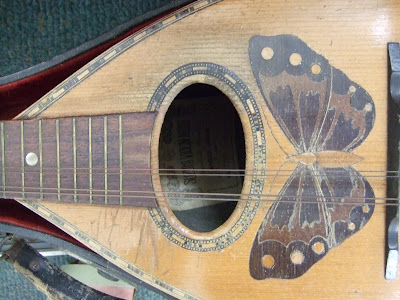
It's missing both sets of upper strings, and the ones on it look like hell, but the sound is still in there somewhere. I'll get it all fixed up in Chicago. Oh, and it's very tiny. If Peri, the Soviet mandolin, was not playing size, this is like a child's. But I had to get it. I paid about US$40. Maybe I could have bargained more, but I think I did all right. The vendor was hesitating, and I gave him my best hopeful puppy eyes -- something I would never do if I could actually communicate with language.
I was going to come up with a cool Japanese name for it, but I'm afraid it's named itself 'Puccini.' You can connect the dots.
Oh, and I was also looking at a taishi-gato, a kind of five-stringed pianolin. You press keys and pick. I would have loved to get it, but it was new, and he was asking US$110. I figured even if I got him down to $50, I'd rather find something old... and I did!
[ETA: make that a taisho-koto.)
I went to the Meiji Park flea market behind the National Stadium in Tokyo today, just one subway stop away, and found myself buying this lovely little thing!

It's a Suzuki Violin company mandolin. According to the vendor, who also had about eight guitars, three tambourines, four harmonicas, and two ocarinas, it was made in 1945. I question his ability to translate numbers into English, but it's certainly possible. The label says Suzuki Violins Kojo, Nagoya. Since Suzuki split hither and yon after the war, I would probably need an expert's help on this one. The writing in the red lining, which was helpfully read to me by a hotel staffer, is just an owner's name and address. When I get around to it, I'll post it on mandolincafe and see who knows what.
In original case, which is worn around the edges but will get it home. Condition is poor. Finish very worn, a couple of tiny cracks in the bowl back where the wood is pulling apart, I think. But look at how lovely it used to be. The inlay around the edge and soundholes is outrageous, and so is that butterfly:

It's missing both sets of upper strings, and the ones on it look like hell, but the sound is still in there somewhere. I'll get it all fixed up in Chicago. Oh, and it's very tiny. If Peri, the Soviet mandolin, was not playing size, this is like a child's. But I had to get it. I paid about US$40. Maybe I could have bargained more, but I think I did all right. The vendor was hesitating, and I gave him my best hopeful puppy eyes -- something I would never do if I could actually communicate with language.
I was going to come up with a cool Japanese name for it, but I'm afraid it's named itself 'Puccini.' You can connect the dots.
Oh, and I was also looking at a taishi-gato, a kind of five-stringed pianolin. You press keys and pick. I would have loved to get it, but it was new, and he was asking US$110. I figured even if I got him down to $50, I'd rather find something old... and I did!
[ETA: make that a taisho-koto.)
Monday, July 6, 2009
Bit by bit
 From a Muscovite poster on MandolinCafe:
Well, most of soviet instruments made at the end of 80s beginning 90s were completely unplayable. Except very rare occasions. There were many political and economical reasons for that. Long story. But on the other hand they have significant historical value Because, mandolins were relatively rare thing in SU. Mass production was only on one factory in Leningrad, and not much of them were produced. Only classic bowelbacks were produced. Most of pro players do not use them anyway because Czechoslovakian mandolins (now Strunal brand) were available and were better. So keep it. It is rare thing :)
This contrasts with a previous Bulgarian poster who told me that tons of mandolins were made for the Western tourist trade, but those were plastic flatbacks and often sold at the big shops near the hotels meant for tourists. My brother also writes that the shop where he bought it had only a few, he thinks, not a whole string of them lining the walls.
He's visiting the U.S. in September, so we're going to wait for him to come peer into the body and read the label. In any case, this is just getting more and more interesting. Playability still up in the air, but the current plan is to buy a gig bag, bring it back to Chicago, and spring for a setup. Even if it's meant for a wall, it wouldn't be a bad thing to have it fixed up, though I suppose that if it really is completely unplayable there's no point in having the bridge in the right place covering the little church picture.
Sunday, June 28, 2009
Bohemian rhapsody

From my brother, re the mandolin dubbed Peri:
I think I bought it on the famous Old Arbat Street bohemian district in Moscow, thus in mid-July 1991. That's the same place where the guy did my portrait, an old Arbat tradition. The portraiters were out in force when I was there again last summer, as were the guys selling paintings. I bought kvas from a stall and wandered around, went into a couple of souvenir shops and a church, and decided against all the overpriced tourist trap eateries. (By the way, back in '91 I got back three weeks, not three days before the attempted coup against Gorbachev.)
He's off to Munich, so I'll have to wait to ask him if he got it from a guy with a thousand mandolins to sell, or a sort of antique/vintage shop/stand. The second would obviously bode much better for the mandolin's construction quality.
Thursday, June 25, 2009
More experimentation?
I am informed by a poster on Mandolin Cafe that the bridge on Peri (short for Perestroika -- how quickly a name sticks) is in the wrong place; it and the nut should be equidistant from the 12th fret. Normally, I might think that there are other variables, etc., but what makes me really suspicious is that the bridge, if it were in the right place, would be right across the onion dome of the church drawn on the top. So I thought, initially, that this meant that I was doomed.
However, further googling tells me that mandolins have movable bridges. There's talk of things like 'setup' and 'moving' and 'placement.' Perhaps there's hope after all. I shall take two sets of extra-light gauge mandolin strings to NJ in a spirit of hopefulness.
Peri is, apparently, a Portuguese-style shallow bowl-back.
However, further googling tells me that mandolins have movable bridges. There's talk of things like 'setup' and 'moving' and 'placement.' Perhaps there's hope after all. I shall take two sets of extra-light gauge mandolin strings to NJ in a spirit of hopefulness.
Peri is, apparently, a Portuguese-style shallow bowl-back.
Getting overambitious

This is the mandolin that my brother bought in the Soviet Union/CIS in 1992 (right before it became not that any more -- as a matter of fact, if I recall correctly, he came home three days before Yeltsin's coup). So it's a piece of specific history. I don't know much about it. I will have to ask him exactly when and where he bought it, as it could have been anywhere along his route. He also bought some assorted Soviet-ish memorabilia, a very nice portrait of himself that my parents still have hanging up, a Gorbachev matrushka doll that has all the previous Soviet leaders inside (the tiniest one is the last czar!), and two of those bobbling wooden dolls that stand up when you tip them over.
I haven't looked at this mandolin in years, though I've been talking about doing something with it on and off for years, but my dad sent me photos at my request so I could think about whether it was playable, and my faithful friend Brent took a look and said he thinks it might be. A quick google tells me that the top wood, which you can't see but has a very straight grain, is quite probably beech or birch. The bridge is probably maple. In other words, it might not be the piece of crap I remember it being. It's a bowl-back, as you might guess. I'm going to take good strings and see what I can do with it in NJ. My real fear is that the tuners just won't hold tune. We'll see.
I've never been one to name inanimate objects other than stuffed animals when I was a child, but I almost feel like this one needs a name. Perestroika, maybe?
Subscribe to:
Posts (Atom)
