All roads lead to the guitar, that's what I say. Who knew that thirty years' worth of dilettante knowledge could come in handy if you just found the right thing to bring it all to life?
All right, the theoretical math itself hasn't come in handy yet, though there's something to that old saw about learning how to study one thing and then being able to study anything. But my two summers at math camp were like a release from the bubble of high school in more ways than one. I don't remember any of my friends in high school being particularly into music, even the band geeks, but at math camp, everyone brought a few cassette tapes. (I am old.) And since Dad only raised me on classical and we only had cable TV for a year (in which I watched much MTV), this is where I really first encountered Simon and Garfunkel, Clapton, Veruca Salt, Lynyrd Skynyrd, U2, Liz Phair... look, it was an eclectic bunch of nerds, all right? For that matter, much of my earlier rock exposure had come via my brother's years at math camp.
What's more, the influence of math camp and my math camp friends led me to start off college as a physics major. A worse idea, in retrospect, could scarcely have been found. Even now, ensconced in English, I do not have what you would call a theoretical mind. I'd have been far better off as an engineer, and the proof of this is that the only thing I was exceptionally good at was the lab component of Physics 15b, Harvard's weirdly named intro course in electricity & magnetism.
Many's the happy hour I spent sprawled out on a dorm floor, sometimes with the door propped open so the smoke and steam from the soldering iron wouldn't touch off the dorm fire alarm. I fried a capacitor once. Let me tell you, that's an unforgettable smell. Years later when my dad's pre-amp blew (with a huge dramatic noise and a roomful of smoke), I diagnosed the problem by smell alone. My friend used to hassle me about taking the time to color-code my wires and trim them all short enough to make the circuits pretty. Our final class project was to build a lamp. I still have it. It doesn't look like a lamp, since it's just a circuit board with a bulb hanging off, but it has a little dimmer and everything.
When I say "I," what I mean is that it's in my parents' basement. My unhandy dad was charmed by the nice red toolbox they gave us in lab and wanted to hang on to it. You know, to save me the inconvenience, since I move often. Well, no more, dad. This time I'm coming for my wire clippers at the very least. And if I end up taking this class at the Chicago Guitar School, I'm coming for the voltmeter, the resistors, the soldering iron... heck, I'm bringing the whole thing back, and damn the airlines!
Tuesday, July 28, 2009

E is for Eagle
E7, Em7 now joined by D7 and Am7. And if anyone is keeping track, the practice song of choice is now "Desperado," which is filled with 7 chords. I must say that the hunt for good practice tabs is giving me a real appreciation for the musical preferences of my favorites. Queen not so heavy on those 7 chords.
I also replaced the pink silk sash on the dreadnought with a real (if not fantastic) strap, tied to the top by a thin pink ribbon which is the remnant of one of my bridesmaid's duties, supplying ribbon to tie little bags of potpourri to pelt the bride and groom. I sense a distinct theme here: keep everything in your closet and it'll come in handy again one day in the most unexpected of places. The strap helps a great deal for fretting and picking with less pain, but I still can't quite see.
I also replaced the pink silk sash on the dreadnought with a real (if not fantastic) strap, tied to the top by a thin pink ribbon which is the remnant of one of my bridesmaid's duties, supplying ribbon to tie little bags of potpourri to pelt the bride and groom. I sense a distinct theme here: keep everything in your closet and it'll come in handy again one day in the most unexpected of places. The strap helps a great deal for fretting and picking with less pain, but I still can't quite see.
Saturday, July 25, 2009
Ship ahoy, or, Female guitarists of the world, unite!
Are all dreadnoughts equal? I spent a happy hour at Guitar Works in Evanston today, sizing guitars, and concluded that folk-sized is easy for me to play (not much bigger than my 3/4, but a longer neck scale), grand concert is manageable, and dreadnought is a little big. Then I came home, put my new guitar on, and said whoa. It just seems enormous. I'm terrible with eyeballing these things.
That being said, the crucial point with this dreadnought is that I can't yet seem to manage to look over the edge of it to see the face while I'm playing. The corollary is that my right arm feels like it's being twisted out of its socket. I suppose I'll adjust, but it raises yet another question: where does the guitar body sit? Over the breasts or under the breasts? Because when I'm sitting down, I would need to grow a few inches to get it under, but obviously if it's over, it sticks out further -- and I don't have an Audrey Hepburn swan neck to help me see.
I facebook-messaged my only female guitarist friend to ask. Her reply:
We female guitarists have to stick together. My sense is to put the guitar over the breasts. It may depend on the shape of the guitar and where it hits the chest, but I think I've always had my chest and body behind the guitars I've had. Maybe because it's a new guitar you have to get used to it and adjust your grips somewhat? I just looked at the new photo of the guitar on your blog--very nice! Yeah, I think when I've played guitars like that (my current Applause acoustic has a rounded back) I've always had my breasts behind the guitar.
This was decidedly not the answer I was expecting; a male friend's reply was that he slings his guitar very low, and that would be his solution. Which would mean I should just always play standing up.
Now, this could all very well be beginner growing pains, but it does also seem like a basic question of positioning, and one that, as I replied to my friend, "is kind of crucial, and something a man (i.e. 99% of guitar salespeople and luthiers) doesn't think about!"
ETA: I was trying to think of female rockers I've seen playing... mostly standing up, of course, and I think slinging under. But sitting down? The only thing I could think of is that scene in Forrest Gump, not my favorite sentimental waltz through American history, in which Jenny is playing guitar nude in a strip bar. It covered everything.
That being said, the crucial point with this dreadnought is that I can't yet seem to manage to look over the edge of it to see the face while I'm playing. The corollary is that my right arm feels like it's being twisted out of its socket. I suppose I'll adjust, but it raises yet another question: where does the guitar body sit? Over the breasts or under the breasts? Because when I'm sitting down, I would need to grow a few inches to get it under, but obviously if it's over, it sticks out further -- and I don't have an Audrey Hepburn swan neck to help me see.
I facebook-messaged my only female guitarist friend to ask. Her reply:
We female guitarists have to stick together. My sense is to put the guitar over the breasts. It may depend on the shape of the guitar and where it hits the chest, but I think I've always had my chest and body behind the guitars I've had. Maybe because it's a new guitar you have to get used to it and adjust your grips somewhat? I just looked at the new photo of the guitar on your blog--very nice! Yeah, I think when I've played guitars like that (my current Applause acoustic has a rounded back) I've always had my breasts behind the guitar.
This was decidedly not the answer I was expecting; a male friend's reply was that he slings his guitar very low, and that would be his solution. Which would mean I should just always play standing up.
Now, this could all very well be beginner growing pains, but it does also seem like a basic question of positioning, and one that, as I replied to my friend, "is kind of crucial, and something a man (i.e. 99% of guitar salespeople and luthiers) doesn't think about!"
ETA: I was trying to think of female rockers I've seen playing... mostly standing up, of course, and I think slinging under. But sitting down? The only thing I could think of is that scene in Forrest Gump, not my favorite sentimental waltz through American history, in which Jenny is playing guitar nude in a strip bar. It covered everything.
Friday, July 24, 2009
The lord giveth...
... barre chords and the lord taketh away power chords. Ow. New neck scale is going to take some getting used to. "Yoga for guitarists' fingers," anybody? Either that or I'm going to have to grow a new pinky.
ETA: Or tilt the neck down slightly. Helps like mad. Of course, I can't see the frets, but this seems to be a general problem with the depth of the dreadnought -- I just haven't figured out yet how I'm supposed to be able to see the face of it.
ETA: Or tilt the neck down slightly. Helps like mad. Of course, I can't see the frets, but this seems to be a general problem with the depth of the dreadnought -- I just haven't figured out yet how I'm supposed to be able to see the face of it.
Thursday, July 23, 2009
Divine chaos
I gym-read a really great book about guitar making, playing, and generally the pleasures of guitar love, Clapton's Guitar by Allen St. John. It's about the long, slow handmaking of an acoustic guitar for Eric Clapton by Wayne Henderson, a great guitarist and greater luthier who lives in his happy little shack in rural Virginia, besieged by requests, eating lemon pie and slowly crafting some of the best guitars in the world in his cluttered, dirty shack of a workshop with his homemade tools. It's a story about inspired craftsmanship, camaraderie (mostly male bonding), fandom, flatpicking, fried turkey, and, of course, Clapton. Clapton doesn't exactly appear; he hovers, godlike, in the background of the book much like he stood in the glassed-in viewing room over his Crossroads guitar auction, which is referenced multiple times. As a matter of fact, Henderson, it seems, almost never talked to Clapton, and the guitar itself was delivered by St. John, who mediated the whole process, to Clapton's gear guy.
That's a little sad in a way, sadder for Clapton than for Henderson, who's not exactly a Clapton fan even if he does seem to like making a guitar for someone so famous. He really missed out by not talking to Henderson himself and seeing his guitar so beautifully shaped. Henderson is a real country character, and St. John a sympathetic, admiring yet hilariously fish-out-of-water narrator. Fantastic read.
That's a little sad in a way, sadder for Clapton than for Henderson, who's not exactly a Clapton fan even if he does seem to like making a guitar for someone so famous. He really missed out by not talking to Henderson himself and seeing his guitar so beautifully shaped. Henderson is a real country character, and St. John a sympathetic, admiring yet hilariously fish-out-of-water narrator. Fantastic read.
Glam rock
After almost dropping the new guitar (which may get a name) three times, I had to put something on it for a strap. No top button, had to tie something onto the neck -- and the only thing I could come up with was a pink silk sash that I wore as a bridesmaid at a wedding in Bermuda.
It doesn't look quite as idiotic as it sounds.
And in other highly exciting news, my F chord is magically working much better on this neck! I wonder if the mystical world of barre chords is going to open up for me now.
It doesn't look quite as idiotic as it sounds.
And in other highly exciting news, my F chord is magically working much better on this neck! I wonder if the mystical world of barre chords is going to open up for me now.
Wednesday, July 22, 2009
Deal or no deal?
Deal. Check out the new addition to the family:
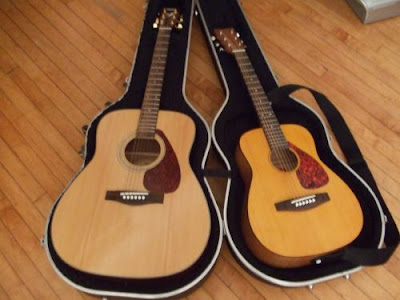
I got this Yamaha F335 for $100, WITH a hardshell case, and not a pasteboard hardshell either. Don't you love this photo of it next to the 3/4 size? It's like a baby guitar and its mommy.
I'm a little less excited than I was originally, because the girl I bought it from gave me the wrong model number. How the hell she did this, I've no idea; it's IN the guitar, for god's sake. So I ended up with a laminate top dreadnought instead of the solid top folk size I thought I was getting, which displeases me quite a bit now that I'm home. When I was playing it, I thought it must be a large folk, but now I think it's a slightly shallow dreadnought. Like I can tell the difference offhand. I'm surprised that I didn't find it more awkward than I did.
Regardless, it's well made and sounds good. Oddly enough, I must have been looking up this model for another ad, because I had read the reviews before, and they're all raves. I'm satisfied. Would NOT be happy if I had paid $100 for the guitar only, but with a case, it's well worth it.
She may have given me the wrong model number out of malice aforethought. Or she may have had no clue. Consider this exchange:
Me: "Uh... have you ever changed the strings?"
She: "Honestly? Um. No, never. I'm pretty sure."
Yup. Explains the little brown spots on them.
ETA: I've never seen such strings, except maybe on my brother's Soviet mandolin. When I say "little brown spots," I mean darker little spots on the completely corroded string length. Restrung with light gauge Martins, letting them stretch. I did a marginally less crappy job than last time; you can probably tell which order I did the strings in, because the first one has maybe one turn around the tuner and the last few have a respectable number, as I finally learned to leave enough slack.
My apartment looks like a musical instrument shop had a birthday and then threw up on it. I am cleaning up the detritus and going to bed.

I got this Yamaha F335 for $100, WITH a hardshell case, and not a pasteboard hardshell either. Don't you love this photo of it next to the 3/4 size? It's like a baby guitar and its mommy.
I'm a little less excited than I was originally, because the girl I bought it from gave me the wrong model number. How the hell she did this, I've no idea; it's IN the guitar, for god's sake. So I ended up with a laminate top dreadnought instead of the solid top folk size I thought I was getting, which displeases me quite a bit now that I'm home. When I was playing it, I thought it must be a large folk, but now I think it's a slightly shallow dreadnought. Like I can tell the difference offhand. I'm surprised that I didn't find it more awkward than I did.
Regardless, it's well made and sounds good. Oddly enough, I must have been looking up this model for another ad, because I had read the reviews before, and they're all raves. I'm satisfied. Would NOT be happy if I had paid $100 for the guitar only, but with a case, it's well worth it.
She may have given me the wrong model number out of malice aforethought. Or she may have had no clue. Consider this exchange:
Me: "Uh... have you ever changed the strings?"
She: "Honestly? Um. No, never. I'm pretty sure."
Yup. Explains the little brown spots on them.
ETA: I've never seen such strings, except maybe on my brother's Soviet mandolin. When I say "little brown spots," I mean darker little spots on the completely corroded string length. Restrung with light gauge Martins, letting them stretch. I did a marginally less crappy job than last time; you can probably tell which order I did the strings in, because the first one has maybe one turn around the tuner and the last few have a respectable number, as I finally learned to leave enough slack.
My apartment looks like a musical instrument shop had a birthday and then threw up on it. I am cleaning up the detritus and going to bed.
Subscribe to:
Posts (Atom)
